Deficits are back thanks to our fearless leader. To keep from defaulting on the national debt (which has never happened in American history!) the Bush gang is raiding federal employee retirement accounts. Sounds like Enronomics to me. Of course, the Clinton gang did the same thing in 1995. Where’s Matt Dillon when you need him?
General
02
Apr 02
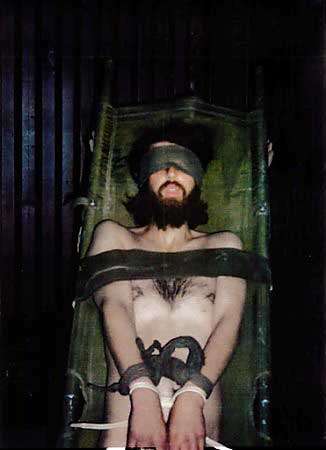
Lindh Torture Evidence
What possible explanation can be used to justify this? Even according to the prosecution Lindh had nothing to do with the death of CIA spook, Johnny Spann. Everything about this whole situation reeks of scapegoating. The US is eager to have something to show for all the fireworks and made-for-tv crap when in reality they have done really nothing. Bombing third-world civilians doesn’t really qualify as a war in my opinion.
02
Apr 02
Warning Labels for Online Games?
A 21 year old man played Everquest minutes before he committed suicide. Now his mom and her lawyers are trying to sue the publisher, Sony, and says online games should come with warning labels. I feel bad that the guy was addicted and depressed, but this is ridiculous.

“I’ve seen a lot of wreckage because of EverQuest,” Parker said. “But they are all the same. It’s like cigarettes. They need to come with a warning label. ‘Warning, extensive playing could be hazardous to your health.’ ”
Warning labels are exactly what Jack Thompson, a Miami attorney and vocal critic of the entertainment industry, wants to result from a lawsuit he plans to file against Sony Online Entertainment for Elizabeth Woolley.
“We’re trying to whack them with a verdict significantly large so that they, out of fiscal self-interest, will put warning labels on,” he said. “We’re trying to get them to act responsibly. They know this is an addictive game.”
“I am sure we are going to find things akin to the tobacco industry memos where they say nicotine is addictive,” he said. “There is a possibility of a class-action lawsuit.”
01
Apr 02
Linkage
Antiwar.com had a slew of great links today, as usual:
- Israeli soldiers executed five of Arafat’s police officers, gangland-style. They each got a steel-jacketed tranquilizer to the dome while they were on their knees. At least that’s what the blood splattered against the wall at three feet high suggests.
- Don’t always trust what they tell you in the war on terror:
Downing Street said al-Qa’ida was using chemical weapons: it was wrong. The Pentagon said Saddam Hussein was to blame for the anthrax attacks on the US: it was wrong. - Turkey considers Kurdish language broadcasts which have been illegal for decades. The European Union has made this a condition for Turkey’s entry into the EU.
- Afghanistan is the Pentagon’s playground for their new killing technology. We have to invade someone every few years to make sure we can still kill effectively. Your tax-dollars pissed away. When will they end military welfare.
Our beloved Google has some competition in the search business. It’s called Teoma. We’ll see. Here’s a story about it at SFGate.com. It couldn’t find my name anywhere on the internet so I’m not impressed yet although according to that article the more advanced search capabilities won’t be unveiled until tomorrow at 5pm eastern.
01
Apr 02
What’s with the Democrats?
Why in God’s name are the Democrats on their knees to help Hollywood pass draconian copyright laws? I know Big Media gives them lots of money, but they could try to make it look a little less like blatant quid pro quo. Email, fax, and call your elected officials and make sure they oppose the Consumer Broadband and Digital Television Promotion Act. I may be forced to vote Republican this year. I’m becoming one of those hard-to-pin-down swing voters. Well, at least Patrick Leahy is opposing this bill. Vermont has the most interesting senators, Patrick Leahy and Jim Jeffords. In the house they have the only socialist, Bernie Sanders.
Related:
01
Apr 02
Best April Fool’s Ever
Well, maybe not ever, but it is funny. I’m glad to see the people at Google have a sense of humor.
01
Apr 02
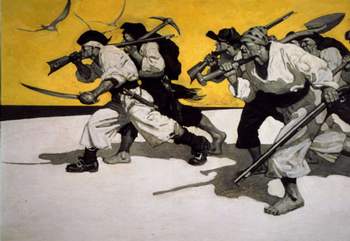
Pro-piracy
Good article on copy-protection standards and copying ‘copy-protected’ CD’s. Rally round the Jolly Roger.
31
Mar 02
Using the Boob Tube
The US propaganda machines love the power of television to manipulate ‘public opinion’. The Pentagon has worked closely with major television networks to roll out an avalanche of programming to exhort the public to patriotic fervor. CBS recently premiered “AFP: American Fighter Pilot“, ABC is planning a reality-type show, “Profiles From the Front Line“, and VH1, not to be outdone, is producing a documentary called “Military Diaries,” in which 60 soldiers were given digital video cameras to record their daily activities. All of these projects are checked and approved by the Pentagon.
I find this troubling:
In a striking demonstration of how the Pentagon’s image builders take Hollywood just as seriously as they take the news media, if not more so, the show’s script writer said he learned details of the intensely debated rules on conducting the controversial tribunals two weeks before Mr. Rumsfeld released them at a news conference on March 21.
The Pentagon was eager to oblige, because, in the wake of Sept. 11, the military sees what television analysts call “militainment” as one of the most effective ways to get its message across, free of the filters of a critical press corps. In addition to “JAG,” the Pentagon is cooperating with three other television shows with military themes, including one on VH1, a cable music channel.
“News used to be the first rough draft of history,” said Robert Lichter, president of the Center for Media and Public Affairs, a nonpartisan research group in Washington. “Now it’s the first draft of a Hollywood screenplay. News and entertainment have merged already. The question now is whose version gets to the public first.“ (No such thing as objective reality?) …
An official at the Pentagon, who did not want his name used, said: “We offer our assistance when we think it is in the best interest of the Department of Defense and our people, and it’s up to the production company to accept it. If they go on and say, `Thanks but no thanks, we won’t make our character be what you stand for,’ we are less inclined to support them.”
Mr. Lichter, the media expert, said he was troubled that people’s knowledge of something as important as military tribunals could be established by television entertainment. “Since the Greeks, we know that drama produces emotional catharsis, but that isn’t the best instrument for producing justice,” he said.
Which is why they use entertainment media, for the emotional effect. Patriotism is the worst sort of nationalistic emotionalism.
The writer of the episode and consulting producer, Mr. Holland, a former Army captain, said he knew that television dramas might be perceived as reality, and so he felt obliged to inject heroism into the story to raise the morale of viewers and troops.
“War is terrible, conflicts are terrible, but somebody has to do it and so it’s necessary — maybe not completely honest, but necessary — to imbue those things with glory,” he said. “I don’t shrink from it.”
31
Mar 02
Bush Rebuff
It’s nice to see the Arab states displaying some backbone by trying to undo the imminent invasion of Iraq by Bush Junior and his thugs.
Baghdad-Kuwait Accord — Support Is Rebuff to Bush’s Efforts
The government in Riyadh is sensitive to the idea that it would be once again seen as an ally in any attack by the United States on Iraq, a Muslim nation. That sensitivity is partly the result of a widespread domestic impression that America’s war on terrorism has actually been an assault on Islam.
In addition, after the Sept. 11 attacks, the Saudis stressed repeatedly that the first step toward ending the terrorism inspired by Osama bin Laden was to solve the Palestinian conflict, which inspires many in the Arab world to take up arms against the United States and its Arab allies.
Today, the message from the Saudis seemed clear. They coordinated an unprecedented Arab peace initiative toward Israel on the very day they also pushed through a surprise Kuwaiti-Iraqi reconciliation, suggesting that if the former problem could be solved, the Iraqi issue could, too.
“I think the Saudis are basically sending a message to the Americans to solve the Palestinian question and things will fall into place,” said George Hawatmeh, the editor of the Jordanian daily Al Rai. “Take care of the Palestinian problem, the mother of all problems, and we will solve the rest in our own way. We will take care of Iraq.”
-
Related:
- The myth that Iraq gassed the Kurds straight from a Pentagon report in 1990. This libel against Iraq is openly expressed by the current administration despite the absence (according to this report) of evidence. It is suggested that Iran was actually responsible for the gas attacks. Of course, Iraq has no love for the independent Kurds, but then neither does Turkey, a strong US ally. The Kurds are surrounded by enemies. A Kurdish proverb says Kurds have “no friends but the mountains.” Turkey is not excited about the potential dissolution of Iraq because it fears this might lead to the creation of an independent Kurdish state which could end up taking a chunk out of Turkey’s borders and drastically change the balance of power in the region. The Kurdish people have an interesting history. The Kurds are the largest ethnic group in the world without a country of their own. The Muslim hero of the Crusades, Saladin (Salah al-Din Yusuf bin Ayub), was a Kurd as was the Persian King Darius.
- More on the Kurds: The Kurd population numbers around 20-25 million and they make up roughly 23% of the Turkish population. Turkey has it’s own history of abuse against the Kurds:
The Treaty of Sèvres (1920), which liquidated the Ottoman Empire, provided for the creation of an autonomous Kurdish state. Because of Turkey’s military revival under Kemal Atatürk, however, the Treaty of Lausanne (1923), which superseded Sèvres, failed to mention the creation of a Kurdish nation. Revolts by the Kurds of Turkey in 1925 and 1930 were forcibly quelled. Later (1937–38) aerial bombardment, poison gas, and artillery shelling of Kurdish strongholds by the government resulted in the slaughter of many thousands of Turkey’s Kurds. The Kurds in Iran also rebelled during the 1920s, and at the end of World War II a Soviet-backed Kurdish “republic” existed briefly.With the overthrow of the Iraqi monarchy in 1958, the Kurds hoped for greater administration and development projects, which the new Ba’athist government failed to grant. Agitation among Iraq’s Kurds for a unified and autonomous Kurdistan led in the 1960s to prolonged warfare between Iraqi troops and the Kurds under Mustafa al-Barzani. In 1970, Iraq finally promised local self-rule to the Kurds, with the city of Erbil as the capital of the Kurdish area. The Kurds refused to accept the terms of the agreement, however, contending that the president of Iraq would retain real authority and demanding that Kirkuk, an important oil center, be included in the autonomous Kurdish region.
In 1974 the Iraqi government sought to impose its plan for limited autonomy in Kurdistan. It was rejected by the Kurds, and heavy fighting erupted. After the establishment of the Islamic Republic in Iran (1979), the government there launched a murderous campaign against its Kurdish inhabitants as well as a program to assassinate Kurdish leaders. Iraqi attacks on the Kurds continued throughout the Iran-Iraq War (1980–88), culminating (1988) in poison gas attacks on Kurdish villages to quash resistance and in the rounding up and execution of male Kurds, all of which resulted in the killing of some 200,000 in that year alone.
With the end of the Persian Gulf War (1991), yet another Kurdish uprising against Iraqi rule was crushed by Iraqi forces; nearly 500,000 Kurds fled to the Iraq-Turkey border, and more than one million fled to Iran. Thousands of Kurds subsequently returned to their homes under UN protection. In 1992 the Kurds established an “autonomous region” in N Iraq and held a general election. However, the Kurds were split into two opposed groups, the Kurdistan Democratic party and the Patriotic Union of Kurdistan, which engaged in sporadic warfare. In 1999 the two groups agreed to end hostilities.
In Turkey, where the government has long attempted to suppress Kurdish culture, fighting erupted in the mid-1980s, mainly in SE Turkey, between government forces and guerrillas of the Kurdistan Workers Party (PKK), which was established in 1984. The PKK has also engaged in terrorist attacks. In 1992 the Turkish government again mounted a concerted attack on its Kurdish minority, killing more than 20,000 and creating about two million refugees. In 1995, Turkey waged a military campaign against PKK base camps in northern Iraq, and in 1999 it captured the guerrillas’ leader, Abdullah Ocalan, who was subsequently condemned to death. Some 23,000–30,000 people are thought to have died in the 15-year war. The legal People’s Democracy party is now the principal civilian voice of Kurdish nationalism in Turkey. The PKK announced in Feb., 2000, that they would end their attacks, but the arrest the same month of the Kurdish mayors of Diyarbakir and other towns on charges of aiding the rebels threatened to revive the unrest. There were also clashes in the 1990s between the Kurds of Turkey and Iraq.
/