I donated some money to my favorite online comic, Cat and Girl, and got a cool drawing.
General
17
Sep 03
Monkeys Show Sense Of Fairness, Study Says
-
Partners of capuchins who made the swap either received the same reward (a cucumber slice), or a better reward (a grape, a more desirable food), for the same amount of work or, in some cases, for performing no work at all.
Brosnan said the response to the unequal treatment was astonishing: Capuchins who witnessed unfair treatment and failed to benefit from it often refused to conduct future exchanges with human researchers, would not eat the cucumbers they received for their labors, and in some cases, hurled food rewards at human researchers.
Those actions were significant. They confirmed that not only did capuchins expect fair treatment, but that the human desire for equity has an evolutionary basis.
16
Sep 03
I sleep on my side
I sleep on my side and back. What does that mean? Study: Sleeping Position Reveals Personality Traits:
-
Crouched in the fetal position is the most popular sleep pattern and favored by 51 percent of women, according to the results of the study he conducted for a large hotel group.
Fetal sleepers tend to be shy and sensitive while people who assume the soldier position, flat on their back with arms at their sides, are quiet and reserved.
Sleeping on one’s side with legs outstretched and arms down in what Idzikowski refers to as the log, indicates a social, easy-going personality. But if the arms are outstretched in the yearner position, the person tends to be more suspicious.
The freefall, flat on the tummy with the hands at the sides of the head, is the most unusual position. Only 6.5 percent of people prefer it and they are usually brash and gregarious.
Unassuming, good listeners usually adopt the starfish position — on the back with outstretched arms and legs.
16
Sep 03
The mushrooms have landed
My front yard has exploded with mushrooms. I counted thirty-four of them just now. It’s neat to see them rise up, get bigger, then flatten out like an opened umbrella.

08
Sep 03
Iraq bits
- The Pentagon’s Bungled Psyops Strategy: “Lt-Col Russell’s superior, Colonel James Hickey, told AP that “enemy tactics are ‘miss and run’. They’re almost running when they pull the trigger. I have yet to see any degree of military competence. They are not experienced fighters. They fire a mortar, then pick up and run . . . ” Colonel Hickey has described, obviously without realising it, the classic tactics of the guerrilla. The sequence of identifying a target, siting a weapon, firing it, then getting out quickly is precisely what guerrilla warfare is all about. Of course the enemy are not “experienced fighters”. And they don’t have “any degree of military competence”. Most are amateurs, ordinary citizens, who hate Hickey and Russell and all they stand for because their soldiers show no respect for their families and especially women in their irreligious, ferocious and intimidating door-crashing house raids in the middle of the night. ”
- US-led occupation brings frontline against al-Qaeda to Iraq: analysts: “The United States struggled before the war to convince the world there was a link between Saddam Hussein and al-Qaeda network, but five months of US-led occupation of Iraq may have created precisely such an unholy alliance.
Stripped of their privileged positions under the ousted dictator’s brutal regime, Saddam’s henchmen may finally have thrown in their lot with their ideological adversaries in Osama bin Laden’s terror network to wage war on their common foe two years after the suicide hijackings in the United States, analysts say.” - The Battle of Algiers and Its Lessons: “The name of Jean-Paul Sartre occurs only once in Pontecorvo’s film, but he played a major role in changing French public opinion. In his introduction to Algerian newspaper editor Henri Alleg’s The Question, Alleg’s account of his own torture at the hands of the Paras, Sartre points to the real issue at stake:
“This rebellion is not merely challenging the power of the settlers, but their very being. For most Europeans in Algeria, there are two complementary and inseparable truths: the colonists are backed by divine right, the natives are sub-human. This is a mythical interpretation of reality, since the riches of the one are built on the poverty of the other. In this way exploitation puts the exploiter at the mercy of his victim, and the dependence itself begets racialism. It is a bitter and tragic fact that, for the Europeans in Algeria, being a man means first and foremost superiority to the Moslems. But what if the Moslem finds in his turn that his manhood depends on equality with the settler? It is then that the European begins to feel his very existence diminished and cheapened.”
If one changes the words ‘settlers’ and ‘colonists’ to ‘American occupiers’ and ‘Algeria’ to ‘Iraq,’ this is not a bad assessment of where the U.S. now finds itself — or may soon find itself. Watching current TV news footage coming out of Iraq — say, of American soldiers patting down Iraqi men at check-points (and putting hoods and plastic handcuffs on some of them) or ransacking private homes — one cannot help but wince at the racial and religious hatreds being sown right before our eyes.”
04
Sep 03
Cats are the ultimate predator
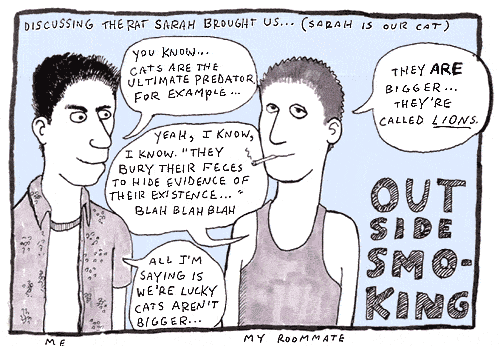
Here’s a comic I drew this morning. It is inspired by the fact that I’ve brought up this topic in conversation with my roommate at least a million times. I tend to repeat myself often. I tend to repeat myself often.
29
Aug 03
JD Drawing
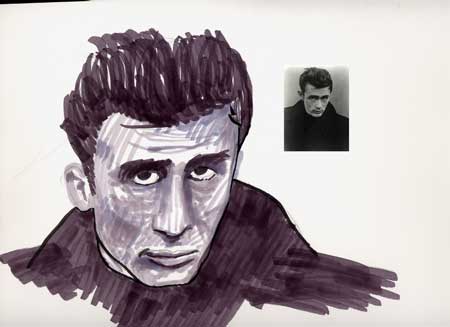
I tried to draw a picture from a photo of James Dean. It didn’t come out looking James Dean to me, but I need the practice. I’m trying to draw a little more all the time. I think in this case, the facial proportions or off leaving him looking a little like an eastern european James Dean. Ah well. I am liking drawing in larger original sizes with the prismacolor markers. It allows me to draw without worrying too much about mistakes or correcting things as you can be loose and still come out okay most of the time. In almost exactly a month (Sept. 30) it will have been 48 years since he died in a car crash.
While looking for photographs on the web I came across some James Dean quotations that I thought were good:
-
“If you’re not afraid…
If you take everything you are,
Everything worthwhile in you,
And direct it at one goal, one ultimate mark,
You’ve got to get there.”
“Dream as if you’ll live forever. Live as if you’ll die tomorrow.”
“The gratification comes in the doing, not in the results.”
“To grasp the full significance of life is the actor’s duty; to interpret it his problem; and to express it his dedication.
Being an actor is the loneliest thing in the world. You are all alone with your concentration and imagination, and that’s all you have. Being a good actor isn’t easy. Being a man is even harder. I want to be both before I’m done.”
“Only the gentle are ever really strong.”
27
Aug 03
Martin Amis snippet on age
I found a good interview in Interview (May 1995) with author Martin Amis. I liked what he had to say on getting older:
Graham Fuller: Turning forty, as Richard and Gwyn do at the start of The Information, and as you did when you began writing it, seemed to be the moment when you realized your mortality, but a moment of relief, as well.
Martin Amis: You’re sort of glad you made it, even to that modest age. You get a dawning awareness of certain things, but it doesn’t come on your fortieth birthday. It comes around thirty-eight or thirty-nine; some people get it much earlier. There’s a youthful illusion that age and death are just a rumor and that, funnily enough, you’ve been picked to defy this law. Intellectually, you’re satisfied that you’re going to get old and die, but you don’t feel it in your gut. That feeling of exclusion from time as a universal process might even be the definition of youth. But around forty the jig is up, really, and it’s a full-time job looking the other way. You can’t get out of the road. It even puts shadows in the orbits of your eyes, that realization, and it changes your balance, your sense of your place in time. Also, you begin to make quite logical but obvious comparisons between what’s gone and what’s to come. And it isn’t good news, on the whole.