01
Apr 02

What’s with the Democrats?

Why in God’s name are the Democrats on their knees to help Hollywood pass draconian copyright laws? I know Big Media gives them lots of money, but they could try to make it look a little less like blatant quid pro quo. Email, fax, and call your elected officials and make sure they oppose the Consumer Broadband and Digital Television Promotion Act. I may be forced to vote Republican this year. I’m becoming one of those hard-to-pin-down swing voters. Well, at least Patrick Leahy is opposing this bill. Vermont has the most interesting senators, Patrick Leahy and Jim Jeffords. In the house they have the only socialist, Bernie Sanders.

Related:


01
Apr 02

Best April Fool’s Ever

Well, maybe not ever, but it is funny. I’m glad to see the people at Google have a sense of humor.


01
Apr 02

Pro-piracy

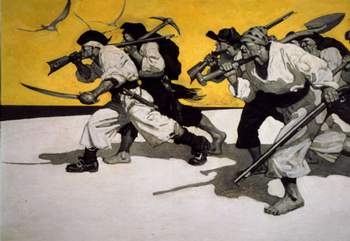
Good article on copy-protection standards and copying ‘copy-protected’ CD’s. Rally round the Jolly Roger.

yo ho ho

31
Mar 02

Using the Boob Tube

The US propaganda machines love the power of television to manipulate ‘public opinion’. The Pentagon has worked closely with major television networks to roll out an avalanche of programming to exhort the public to patriotic fervor. CBS recently premiered “AFP: American Fighter Pilot“, ABC is planning a reality-type show, “Profiles From the Front Line“, and VH1, not to be outdone, is producing a documentary called “Military Diaries,” in which 60 soldiers were given digital video cameras to record their daily activities. All of these projects are checked and approved by the Pentagon.

I find this troubling:


    In a striking demonstration of how the Pentagon’s image builders take Hollywood just as seriously as they take the news media, if not more so, the show’s script writer said he learned details of the intensely debated rules on conducting the controversial tribunals two weeks before Mr. Rumsfeld released them at a news conference on March 21.

    The Pentagon was eager to oblige, because, in the wake of Sept. 11, the military sees what television analysts call “militainment” as one of the most effective ways to get its message across, free of the filters of a critical press corps. In addition to “JAG,” the Pentagon is cooperating with three other television shows with military themes, including one on VH1, a cable music channel.

    “News used to be the first rough draft of history,” said Robert Lichter, president of the Center for Media and Public Affairs, a nonpartisan research group in Washington. “Now it’s the first draft of a Hollywood screenplay. News and entertainment have merged already. The question now is whose version gets to the public first.“ (No such thing as objective reality?) …


    An official at the Pentagon, who did not want his name used, said: “We offer our assistance when we think it is in the best interest of the Department of Defense and our people, and it’s up to the production company to accept it. If they go on and say, `Thanks but no thanks, we won’t make our character be what you stand for,’ we are less inclined to support them.”

    Mr. Lichter, the media expert, said he was troubled that people’s knowledge of something as important as military tribunals could be established by television entertainment. “Since the Greeks, we know that drama produces emotional catharsis, but that isn’t the best instrument for producing justice,” he said.

Which is why they use entertainment media, for the emotional effect. Patriotism is the worst sort of nationalistic emotionalism.


    The writer of the episode and consulting producer, Mr. Holland, a former Army captain, said he knew that television dramas might be perceived as reality, and so he felt obliged to inject heroism into the story to raise the morale of viewers and troops.

    “War is terrible, conflicts are terrible, but somebody has to do it and so it’s necessary — maybe not completely honest, but necessary — to imbue those things with glory,” he said. “I don’t shrink from it.”

31
Mar 02

Bush Rebuff

It’s nice to see the Arab states displaying some backbone by trying to undo the imminent invasion of Iraq by Bush Junior and his thugs.

Baghdad-Kuwait Accord — Support Is Rebuff to Bush’s Efforts


    The government in Riyadh is sensitive to the idea that it would be once again seen as an ally in any attack by the United States on Iraq, a Muslim nation. That sensitivity is partly the result of a widespread domestic impression that America’s war on terrorism has actually been an assault on Islam.

    In addition, after the Sept. 11 attacks, the Saudis stressed repeatedly that the first step toward ending the terrorism inspired by Osama bin Laden was to solve the Palestinian conflict, which inspires many in the Arab world to take up arms against the United States and its Arab allies.

    Today, the message from the Saudis seemed clear. They coordinated an unprecedented Arab peace initiative toward Israel on the very day they also pushed through a surprise Kuwaiti-Iraqi reconciliation, suggesting that if the former problem could be solved, the Iraqi issue could, too.

    “I think the Saudis are basically sending a message to the Americans to solve the Palestinian question and things will fall into place,” said George Hawatmeh, the editor of the Jordanian daily Al Rai. “Take care of the Palestinian problem, the mother of all problems, and we will solve the rest in our own way. We will take care of Iraq.”

    Related:

  1. The myth that Iraq gassed the Kurds straight from a Pentagon report in 1990. This libel against Iraq is openly expressed by the current administration despite the absence (according to this report) of evidence. It is suggested that Iran was actually responsible for the gas attacks. Of course, Iraq has no love for the independent Kurds, but then neither does Turkey, a strong US ally. The Kurds are surrounded by enemies. A Kurdish proverb says Kurds have “no friends but the mountains.” Turkey is not excited about the potential dissolution of Iraq because it fears this might lead to the creation of an independent Kurdish state which could end up taking a chunk out of Turkey’s borders and drastically change the balance of power in the region. The Kurdish people have an interesting history. The Kurds are the largest ethnic group in the world without a country of their own. The Muslim hero of the Crusades, Saladin (Salah al-Din Yusuf bin Ayub), was a Kurd as was the Persian King Darius.
  2. More on the Kurds: The Kurd population numbers around 20-25 million and they make up roughly 23% of the Turkish population. Turkey has it’s own history of abuse against the Kurds:

      The Treaty of Sèvres (1920), which liquidated the Ottoman Empire, provided for the creation of an autonomous Kurdish state. Because of Turkey’s military revival under Kemal Atatürk, however, the Treaty of Lausanne (1923), which superseded Sèvres, failed to mention the creation of a Kurdish nation. Revolts by the Kurds of Turkey in 1925 and 1930 were forcibly quelled. Later (1937–38) aerial bombardment, poison gas, and artillery shelling of Kurdish strongholds by the government resulted in the slaughter of many thousands of Turkey’s Kurds. The Kurds in Iran also rebelled during the 1920s, and at the end of World War II a Soviet-backed Kurdish “republic” existed briefly.

      With the overthrow of the Iraqi monarchy in 1958, the Kurds hoped for greater administration and development projects, which the new Ba’athist government failed to grant. Agitation among Iraq’s Kurds for a unified and autonomous Kurdistan led in the 1960s to prolonged warfare between Iraqi troops and the Kurds under Mustafa al-Barzani. In 1970, Iraq finally promised local self-rule to the Kurds, with the city of Erbil as the capital of the Kurdish area. The Kurds refused to accept the terms of the agreement, however, contending that the president of Iraq would retain real authority and demanding that Kirkuk, an important oil center, be included in the autonomous Kurdish region.

      In 1974 the Iraqi government sought to impose its plan for limited autonomy in Kurdistan. It was rejected by the Kurds, and heavy fighting erupted. After the establishment of the Islamic Republic in Iran (1979), the government there launched a murderous campaign against its Kurdish inhabitants as well as a program to assassinate Kurdish leaders. Iraqi attacks on the Kurds continued throughout the Iran-Iraq War (1980–88), culminating (1988) in poison gas attacks on Kurdish villages to quash resistance and in the rounding up and execution of male Kurds, all of which resulted in the killing of some 200,000 in that year alone.

      With the end of the Persian Gulf War (1991), yet another Kurdish uprising against Iraqi rule was crushed by Iraqi forces; nearly 500,000 Kurds fled to the Iraq-Turkey border, and more than one million fled to Iran. Thousands of Kurds subsequently returned to their homes under UN protection. In 1992 the Kurds established an “autonomous region” in N Iraq and held a general election. However, the Kurds were split into two opposed groups, the Kurdistan Democratic party and the Patriotic Union of Kurdistan, which engaged in sporadic warfare. In 1999 the two groups agreed to end hostilities.

      In Turkey, where the government has long attempted to suppress Kurdish culture, fighting erupted in the mid-1980s, mainly in SE Turkey, between government forces and guerrillas of the Kurdistan Workers Party (PKK), which was established in 1984. The PKK has also engaged in terrorist attacks. In 1992 the Turkish government again mounted a concerted attack on its Kurdish minority, killing more than 20,000 and creating about two million refugees. In 1995, Turkey waged a military campaign against PKK base camps in northern Iraq, and in 1999 it captured the guerrillas’ leader, Abdullah Ocalan, who was subsequently condemned to death. Some 23,000–30,000 people are thought to have died in the 15-year war. The legal People’s Democracy party is now the principal civilian voice of Kurdish nationalism in Turkey. The PKK announced in Feb., 2000, that they would end their attacks, but the arrest the same month of the Kurdish mayors of Diyarbakir and other towns on charges of aiding the rebels threatened to revive the unrest. There were also clashes in the 1990s between the Kurds of Turkey and Iraq.
      /


31
Mar 02

Pope Secretly Pardoned Templars

Interesting article in The London Times on new evidence relating to the destruction of the Knights Templar by the Vatican and Prince Philip the Fair. This episode is the main reason the Masons have a historical animosity towards the Catholic Church:


    Vatican file shows pope pardoned massacred Knights

    L’Avvenire, the Catholic daily, said that the record of the Pope’s investigation was thought to have been lost when Napoleon looted the Vatican during his invasion of Italy in the 18th century, and that its rediscovery was an exceptional event.

    The Templar Grand Master, Jacques de Molay, was burnt at the stake on the orders of Philip IV of France (known as Philip the Fair), who coveted the Templar order’s land and treasure and began a campaign of dawn arrests and torture in 1307. At least 2,000 Knights were killed in an attempt to obliterate the order altogether. It was revived in the 18th century as part of the masonic movement, which is said to have inherited some of the Templars’ secret rituals.

    Barbara Frale, a researcher at the Vatican School of Paleontology, said that the consensus among historians was that Clement V, who was himself French and a former Archbishop of Bordeaux, had been pliant and weak, and had colluded in Philip the Fair’s scheme to wipe out the Templars and seize their fortune. But documents found in the Vatican archives, including a long-lost parchment, proved that the Pope had in fact manoeuvred ‘with skill and determination’ to ensure that his own emissaries questioned de Molay and other leading Templars in the dungeons of Chinon castle in the Loire in 1308, in what amounted to a papal trial.

    Signora Frale, who is writing a book based on the Chinon parchment, told the Italian monthly Hera, a journal of historical mysteries, that the result was the complete exoneration of the Knights.

    The Pope had accepted the Knights� explanation that the charges against them of sodomy and blasphemy were due to a misunderstanding of arcane rituals behind closed doors which had their origins in the Crusaders� bitter struggle against the Muslims, or Saracens. These included �denying Christ and spitting on the Cross three times�, as well as �kissing other men�s behinds�. Adriano Forgione, editor of Hera, said that these were intended to simulate the kind of humiliation and torture that a Crusader might be subjected to by the Saracens if captured. They were taught how to abuse their own religion �with the mind only and not with the heart�.

    The Knights Templar � properly called The Poor Knights of Christ and the Temple of Solomon � were founded during the early Crusades in the 12th century, when they protected pilgrims to the Holy Land, together with the Hospitallers (or Knights of St John). The Templars were so called because they were given part of the former Temple of Solomon in Jerusalem as their headquarters.

    Noting that de Molay and the Knights had asked his pardon, the Pope wrote: �We hereby decree that they are absolved by the church and may again receive Christian sacraments.� Signor Forgione said that the Pope had failed to make this absolution public because the scandal of the Templars had aroused extreme passions and he feared a church schism. Philip IV had de Molay and other Templar leaders put to death before the Pope�s verdict could be published, and it was subsequently lost.

.heramagazine.net/home2.html”>Hera Magazine of Archaeological Mysteries I hope you can read Italian. If not you might try translating it with google.

  • Philip IV – 1268 – 1314: The Man Who Brought The Templars Down
  • The Knights Templar entry in the Catholic Encyclopedia
  • A page called GREAT THEOSOPHISTS. Has some info on the Knights Templar and their struggle against the Catholic Church and their own shocktroops, the Jesuit Order.

  • 31
    Mar 02

    WAR-TIMES.ORG

    From The Guardian: New US paper aims at Afghan war truth:


      A newspaper aimed at providing news of the war in Afghanistan is to be launched this month. Its editors argue that the mainstream media in the US are not providing a full picture of the war and its effects.
      War Times, produced in San Francisco, will make its first bi-weekly appearance on April 12. It will be published in English and Spanish and will be distributed throughout the US.

      Its editors say it is a response to a demand for more information about what is happening in Afghanistan and the possibility of conflict elsewhere.

      The venture is supported by a number of academics, including Noam Chomsky, labour organisations and anti-war groups.

      Its managing editor, Bob Wing, said the response to the idea had been extraordinary. “We originally planned to print only 7,500 copies of the pilot,” he said, “but the demand was so great that we printed and distributed 100,000.”


    29
    Mar 02

    Online Forensics

    There was a good article about some of the methods ‘terrorists’ have used to evade law enforcement. Even though you often hear stories which would give the impression that the intelligence community is omniscient, common sense should tell you that it should not be that hard to conduct business outside the view of the Roving Eye, even if you are a highly-sought individual. It turns out that the eyes and ears in the NSA/Echelon/CIA have a few obvious vulnerabilities. First, as bureaucratic institutions they move slowly and make mistakes having to rely on many imperfect highly indoctorinated individuals. Even arranged as they are with a clear top-down, linear command structure this inefficiency is a problem. Secondly, it is easier to hide something than to find something. According to this article in the NY Times and other articles I have seen the terrorists have shown suprising ingenuity in concealing their communications. They have moved away from communications which are easily penetrated by governmental powers. For example, cell phone and satellite phone networks have built-in backdoors for the NSA and global law enforcement. Other things like radio are heavily monitored. Although, these groups would be shielded from greater detection if they utilized multiple strategies such as encrypting radio transmissions and band-jumping to keep the signal hard to pinpoint, though the presence of signal hopping can be detected. Terrorist organizations have successfully been using more decentralized methods of concealing their information. They have used newsgroups and forums to post coded messages. Websites have many advantages. They are decentralized global communications and can preserve communication almost permanently. This is really a good solution as you are essentially hiding information out in the open. Unlike email which is can be easily traced and intercepted, encrypted instant messaging, chat, and websites have many advantages. Out of the way, innocuous-looking websites can serve as internet dead drops. Coded information can be concealed within the body of a site, or within a newsgroup and can be left for months or years. Presumably, if you were a member of such an organization you might receive word from a contact about where to find information and instructions posted. If it is encrypted all the better. Once compromised this could add to the process keeping law enforcement delayed. The point is, that if you are determined to stay ahead of the game it is not that difficult. Most often surveillance powers are overestimated. They still rely on imperfect human beings. Certainly, anyone who would go to work as a government goon has already demonstrated a lack of judgement. If only we could send all terrorists and their twins in our government to another planet where they could duke it out. Warfare and violence are idiotic and insane. In the 20th century an estimated 120 million people died as the result of war. It needs to end.


    29
    Mar 02

    Fooling the Women

    Bush Junior and his crew are concerned with what the women think about the ‘war on terror’. Concerned that Americans are losing their taste for world domination the Bush gang has tried to enlist Oprah Winfrey to steer the opinions of her estimated 22 million predominantly female viewers. They had hoped to stake their claim on television as the world liberators of oppressed women. Unfortunately, this claim is laughable. The US actively supports governments like in Saudi Arabia who are as bad or worse as the Taliban with regards to gender equality. This attempt to justify the US actions in terms of increasing the freedom of Afghan women is really funny. Every time I see someone on TV speaking earnestly about how the US has freed Afghan women I have to be cynical. A scant few months ago the US was an active supporter of the Taliban regime.


      Bush’s political advisers are concerned that some key voting groups, while supportive of the war on terrorism, may be growing weary of the constant talk of killing and brutality. The Oprah strategy was devised to dampen the images of global violence.

      Despite the rebuff from Winfrey, the president has begun to push that message. He told audiences in three states this week how the young girls finally have been liberated from Taliban rule and are resuming their studies after being banned from schoolrooms in 1996.

      “I like to assure my fellow citizens that we don’t seek revenge, we seek justice,” Bush told a Dallas political gathering Thursday, taking a break from his Easter vacation at his Texas ranch. “And it’s important for the young in America to understand that when we went into Afghanistan, we went in not as conquerors, but as liberators.”

    Don’t you feel like a liberator? I’m sure all the thousands and millions of Afghans who have had their country invaded and their homes bombed and their families murdered by US bombs feel ‘liberated’.